Life at Automattic: Communication is oxygen
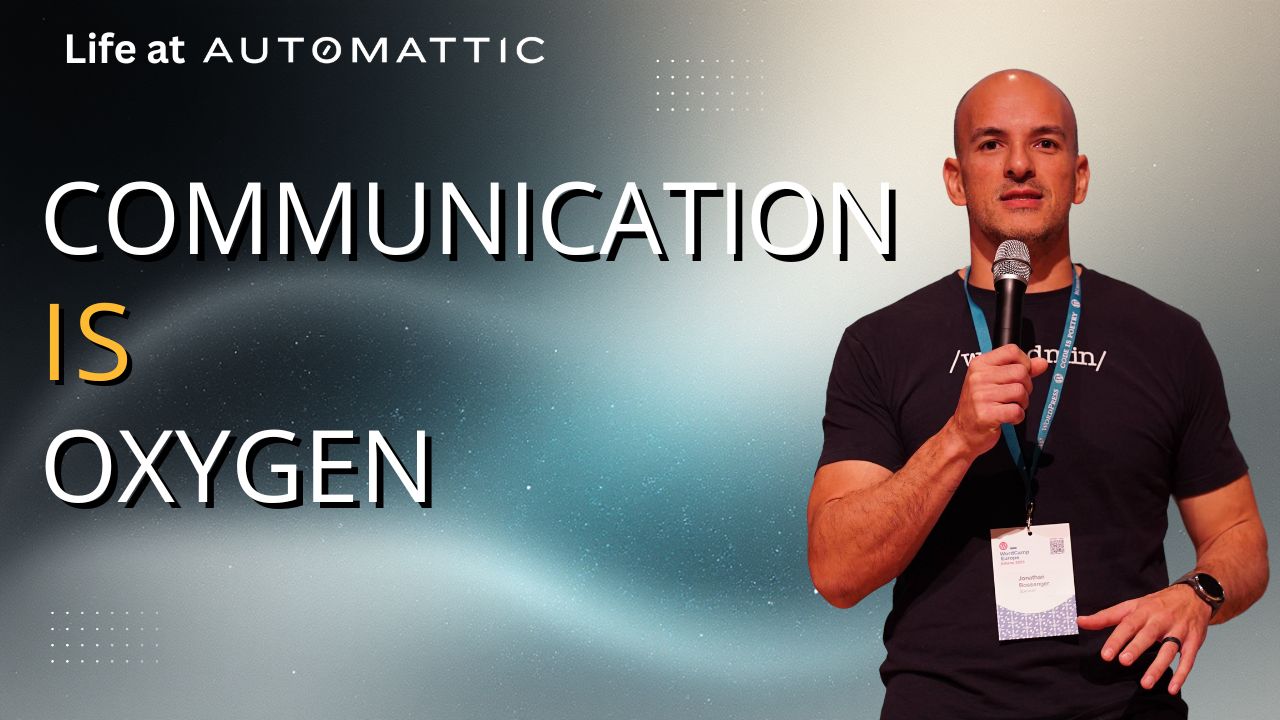
I’ve started a new series on my YouTube channel, all about my work at Automattic.
So if you subscribe to this channel. You probably come here for like WordPress stuff or WordPress development stuff, or development AI stuff. Just stuff to do with development. But I kind of wanna start a new series of videos on this channel. It’s something I’ve been thinking about for a while. It’s something that, I never thought I would do. It’s a little bit more personal, it’s a little bit more involved in what I do day to day, my work, the company I work for, that kind of thing. A number of people have asked me over the years how I got from being a developer to being a developer educator or advocate or whatever you wanna call what I do now.
And so I wanna do a couple of videos around that topic. I’m gonna transcribe these for my blog. The transcriptions are probably going to be ugly if you’re reading this because I’m going to literally just transcribe and post. So there will be ums and ahs because that’s kind of how I speak, but it’s going to be a little bit more, I suppose, detail about how I work and what I do and things that I learn and lessons that I’ve learned.
So I hope you enjoy.
And the topic for the first video is all around communication. I work for a company which is distributed all over the world. You go onto our website, you check out the, where we are, link, and you’ll see we’re literally on practically every continent. I think the only place we don’t have somebody is Antarctica and maybe Russia, but I think that’s changed.
And with a company so spread out all over the world and time zones being a thing, and daylight savings being another thing that I don’t understand but happens, You really have to have a robust sense of how to communicate across time zones and different work lives, and working from home and working in offices and all that kind of thing.
And one of the things that I think Automattic does really, really well, is make communication something that is part of the core of the company. One of the tenets of our creed is that communication is oxygen of a distributed company. And so how we communicate and the way we communicate with each other is just part of the way we do things.
And the two things that have stood out for me in the last almost four years that I’ve worked here is that, unless it’s really, really, really urgent, communication happens all the time and asynchronously. So what I mean by that is I can, in a P2 post, in a Slack channel, I can share a message, I can tag a bunch of people, and they will get back to me when they come online, and that’s just normal.
And I will respond to them when I’m back online and we’ll just have this asynchronous conversation. But what that means is that sometimes you wait a little bit for a response. And so you need to be able to put yourself in a position where the response is not something that you need super, super urgently.
That having been said, if you do need an urgent response, you can contact other people outside of your team to find the information that you need. There’s always somebody online somewhere and they can help you hunt down what you’re looking for. And so one of the things that it took me a while to get over or get used to was just being able to pop into any team channel and just say, Hey, I need help, and folks will help you.
It’s another tenet of our creed and the fact that I will never pass up the opportunity to help another colleague. And so even when I’m stuck and I need assistance, I will find somebody who can help me. And then the other side of it is the depth and breadth of our P2 system. Now, if you haven’t heard about P2, it’s essentially, a custom theme and series of plugins for WordPress. You can install, you can set up P2s by going to wordpress.com and creating a new site and assigning it as a P2, I think it is. I can’t remember. I haven’t done it in a while, but it is really useful for communicating information across time.
Before I joined Automatic, I used P2s for communication, for organizing WordCamps because I needed a place to save all the conversations, save all the meeting notes, save all the documents that we were uploading and passing around. And email just doesn’t cut it because you have to tag a whole bunch of people.
You have to cc a whole bunch of people in an email and then somebody else comes into the conversation. Now you’ve gotta add them to the email chain. Whereas if you just P2 it, it’s there forever. And that’s kinda one of the superpowers of Automattic. I can go in and search through our vast myriad of P2s and find conversations about things that happened before I joined the company, before I joined WordPress.
It’s all just there. I can go back on historical information from the start of the company and find things out, and that is really, really powerful because that means every piece of information. Every conversation that’s ever happened is available and searchable and indexable, and you can find it. And so when you combine this internal acceptance of asynchronous communication with a bunch of colleagues who will help you find the information you’re looking for with all the information since the start of the company available and searchable and indexable you just have this communication system that just keeps working.
It’s one of the many things that I enjoy about working at this company is I have access to every single piece of conversation and information that has ever happened across the company. And it is open to me and it is publicly accessible to me. And it’s something really, really amazing and it’s something that I’ve never really seen anywhere else.
And so that’s that for this video. I just wanted to share a little bit of the inner workings of how we communicate as a company. I hope you liked the video. If you did like it, gimme a, like, gimme a subscribe. If you didn’t like it, lemme know in the comments. I’m gonna try and do a few more of these every couple of weeks and we’ll see how it goes.
But that’s it for now. Bye.
Leave a Reply